
A camera bundle and a subscription solve different problems. The first decides what arrives in the box.
The second determines which continuing services and discounts the customer can use. A page becomes misleading when a single checkbox appears to settle both.
GoPro’s HERO13 Black purchase page is a useful case because it exposes editions, HB-Series lenses, value labels and separate subscription information.
This article preserves that detailed interface analysis, while separating observed facts from recommendations for a Shopify implementation.
We observed the US English pages on November 13, 2026; we did not purchase a product, access GoPro’s backend or measure its conversion results.
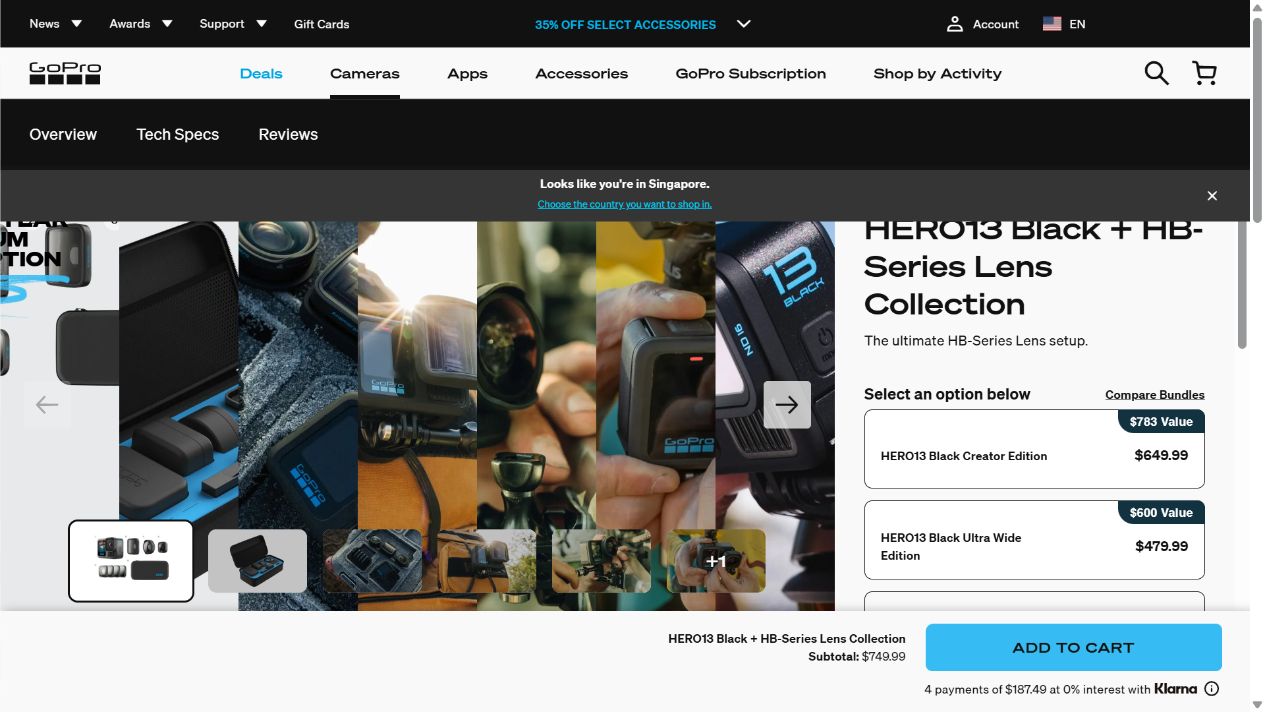
Source: GoPro’s official purchase page.
Keep the subscription discoverable, without inventing its importance
The observed navigation includes Deals, Cameras, Apps, Accessories, GoPro Subscription and Shop by Activity.
The subscription has a clear destination; it is not the first navigation item.
That distinction matters because a design analysis should describe the interface rather than manufacture a commercial strategy from an inaccurate screenshot.
The current US subscription page shows Premium at $59.99 per year and Premium+ at $99.99.
Promotional first-period offers, if present, must be checked separately from renewal pricing.
The unlimited storage language applies to eligible GoPro footage, excluding Fusion content.
Non-GoPro footage has an allowance: 100GB for Premium and 500GB for Premium+.
Camera replacement is also conditional.
The page describes up to two same-model replacements per year, with fees and country/model restrictions. “Two free replacements” would be an incorrect summary.
Selected accessory discounts have exclusions and an allowance of ten items per twelve months; not every lens receives the same percentage reduction.
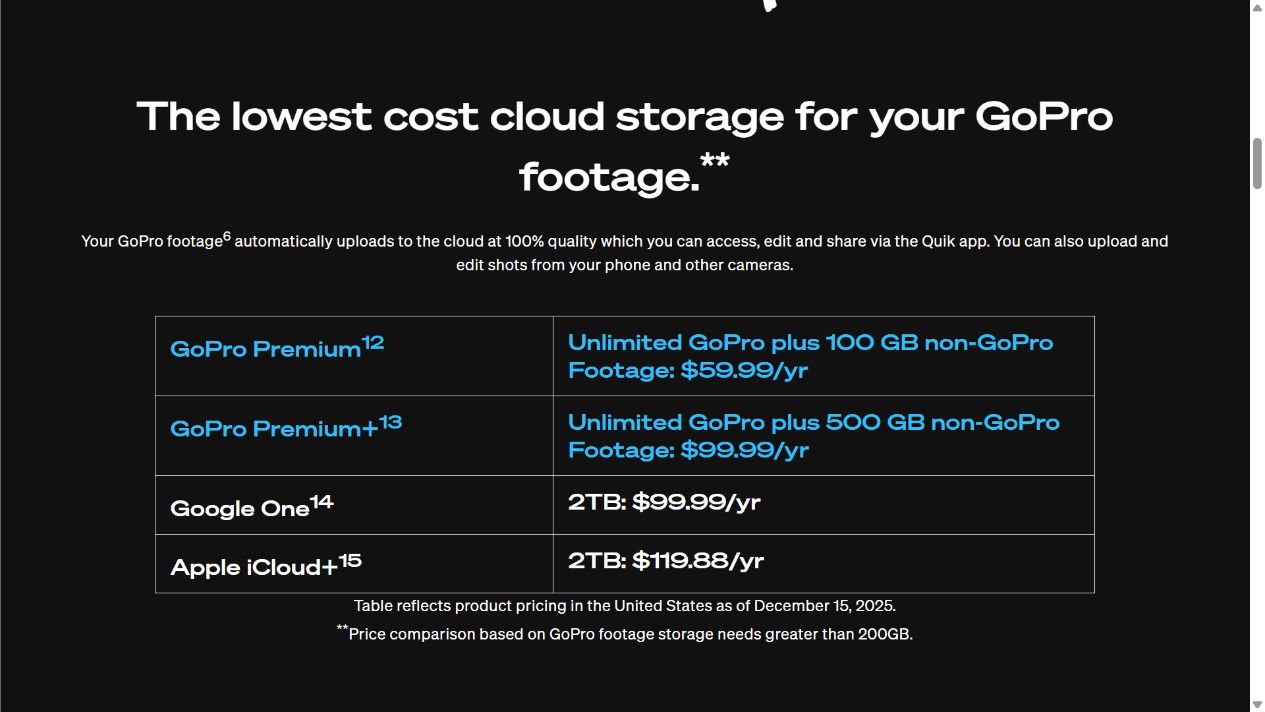
Sources: Subscription benefits and subscription terms.
Recalculate the discount example
GoPro’s Forest Green product news listed the Ultra Wide Lens Mod at $119.99, or $95.99 for subscribers; Macro at $149.99, or $119.99; Anamorphic at $149.99, or $119.99; and the ND four-pack at $89.99, or $71.99.
These remain useful examples of a two-price presentation, but they are historical news prices, not a promise about every current checkout.
In that example, buying Ultra Wide and Macro produces $24 plus $30 in listed savings: $54.
Against the currently displayed $59.99 annual fee, this is $5.99 short.
The conclusion cannot be “two lenses pay for membership.” Show the actual eligible basket, current discount and subscription charge, then let the buyer decide whether the remaining services have value to them.
Value labels need a checkable basis
The purchase page presents several editions, including Ultra Wide and a build-your-own bundle.
The four core categories below retain the original manuscript’s comparison, with the observed prices and availability rather than an assumed historical range.
| Edition | Displayed value | Observed sale price | Contents or decision to inspect |
|---|---|---|---|
|
HERO13 Black standalone |
Baseline camera offer |
$429.99; temporarily out of stock |
Camera, 1900mAh Enduro battery and basic mounting contents. |
|
Accessories Bundle |
$518 Value |
$479.99; temporarily out of stock |
The Handler, two Enduro batteries and the listed mounting/case contents. |
|
Creator Edition |
$783 Value |
$649.99 |
Volta, Media Mod, Light Mod and the listed mounting equipment. |
|
HB-Series Lens Collection bundle |
$880 Value |
$749.99 |
Ultra Wide, Macro, Anamorphic, the ND four-pack and the lens case. |
The comparison drawer lets the reader inspect the equipment instead of deciding from a package name.
This is particularly useful when two expensive editions serve different workflows: the Creator Edition is not simply a lower tier of the complete lens collection.
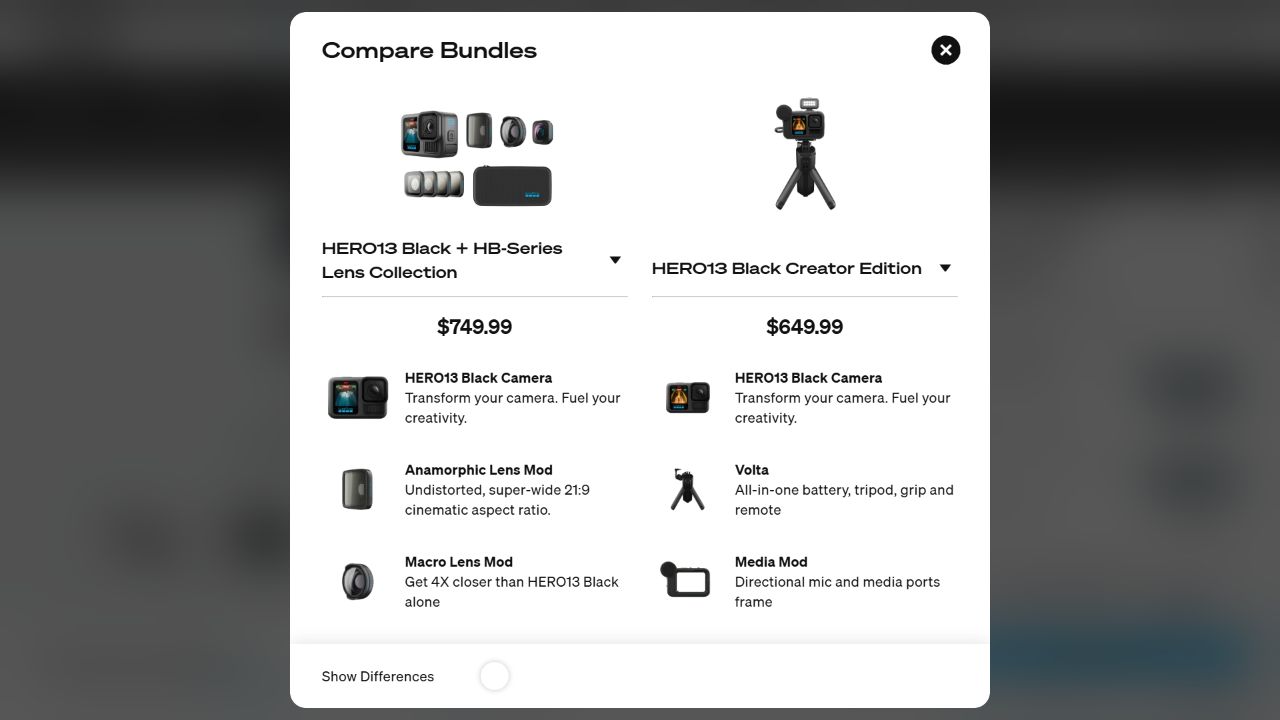
Source: Compare Bundles on GoPro’s purchase page.
Subtracting $649.99 from $783 gives a displayed difference of $133.01.
That is not a cash rebate or evidence that the bundle will save every shopper money.
Someone who does not need a light or handle should not be told that the entire difference is a personal benefit. A Shopify implementation should retain the dated basis for its single-item total and keep it separate from the actual selling price and compare-at price.
Turn an optical feature into an understandable task
HB-Series Auto-Detect explains why a buyer might add a specialised lens without learning every setting first.
Compatible lenses and filters can be detected and corresponding settings adjusted.
The exact behaviour depends on the module and firmware; not every accessory simply enters an identical Auto Cinematic mode.
HERO13 Black’s 8:7 capture format supports later reframing for horizontal and vertical publication.
Here “frame” describes an aspect ratio, not a 35mm full-frame sensor.
Cropping discards part of the captured area and pixels, so “lossless horizontal and vertical output” would be too broad.
Mounting is another concrete explanation.
The camera’s mounting arrangement combines folding fingers, a 1/4-20 connection and compatibility with Magnetic Latch equipment.
An optional accessory should remain visibly optional, with its exact compatibility and included parts checked, rather than becoming a promise that every mounting method is in every box.
Put exclusions where an upgrading customer will find them
The FAQ says the new 1900mAh Enduro battery is not compatible with older GoPros.
It also says the body still fits the HERO12 Black Protective Case and Media Mod.
Those are separate statements: a customer cannot infer battery compatibility from an accessory retaining the same product-family name.
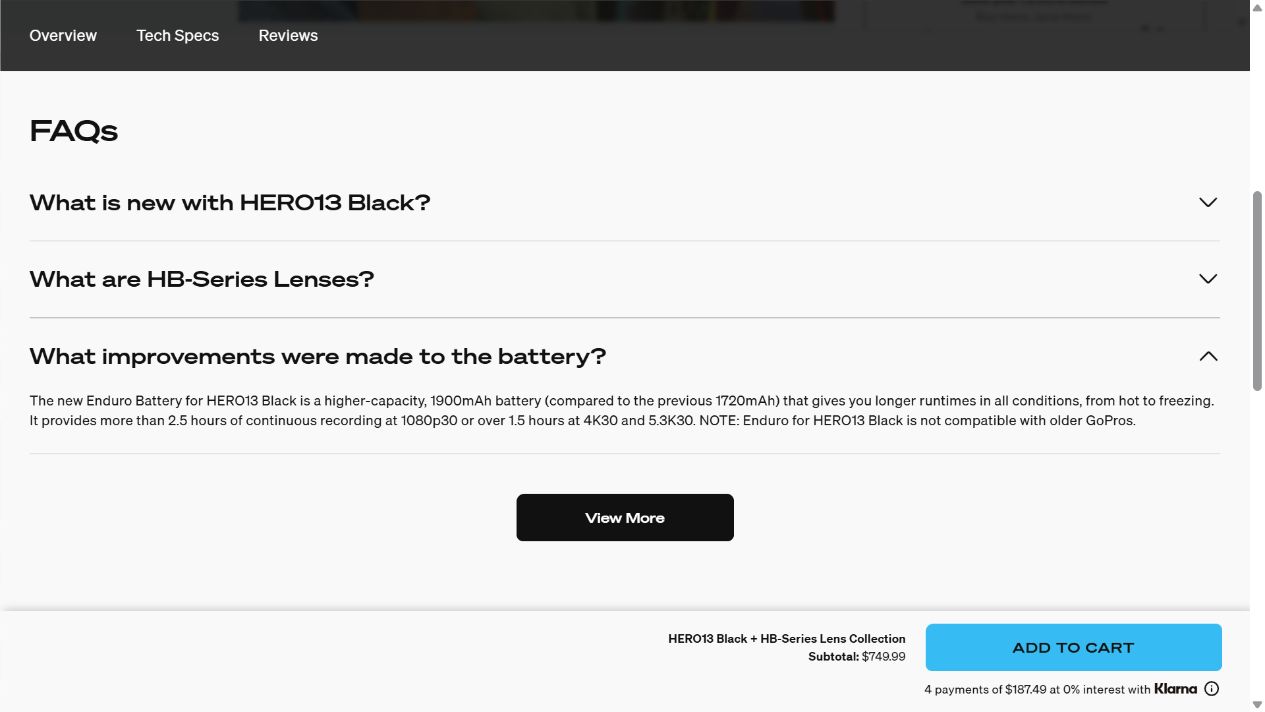
Source: GoPro’s HERO13 Black FAQ.
The subscription page’s Fusion exclusion is a different compatibility dimension again. A storefront should maintain camera-to-battery, camera-to-lens and footage-to-service rules separately. A single “compatible with GoPro” badge cannot carry all three meanings.
What the original Shopify prototype does, and what it still needs
The complete fact-corrected Liquid file remains available.
It demonstrates edition cards, lens selections, a subscription checkbox and a displayed total.
It does not verify a customer’s membership, apply an authorised discount, create a selling plan, issue benefits or perform a real cart request.
Treat its fixed prices as historical prototype data.
For production, first map each edition and separately sold lens to actual saleable variants.
Keep a membership-independent contents list so that selecting a lens collection does not silently add the same lenses again.
Read availability and market pricing from the commerce system.
Then establish where membership status is stored and how it is validated. A browser checkbox cannot be the authority for discounted prices.
The discount needs an appropriate backend rule, and the cart/checkout must confirm its application.
Check guests, active members, expired members and people whose cancelled subscription remains valid until the end of the paid period.
If a service recurs, use an appropriate subscription application and selling plan integration.
Present the charge period, renewal amount and cancellation route before purchase, with affirmative consent.
Adding an ordinary one-time product to the cart does not create subscription billing.
Finally, test unavailable editions, unavailable add-ons, excluded discounts, duplicate submissions and failed payment.
Compare the selected offer with the actual cart response and test order.
Check both the charge and the entitlement: a correctly charged order with no activated service is still a broken experience.
WESWOO uses this kind of case analysis to connect whole-store interface design with product data, eligibility, pricing and fulfilment.
The transferable lesson is not to give every hardware product an annual fee.
It is to explain the continuing service first, then build a transaction that delivers exactly that service.
The complete prototype keeps its UI structure, with factual copy and the default paid-selection state corrected.
The untouched original remains archived; this is still not a production transaction integration.
WESWOO - 跨境独立站开发专家
助力中国品牌出海,我们为您提供专业的独立站搭建和Shopify Plus集成技术服务。精准的跨境电商解决方案,助力品牌在全球市场成功落地,轻松跨越国界。
- shopify独立站品牌化
- 海外UI视觉设计
- SNS多渠道品牌营销