
Imagine an apron store telling a compelling story about its founder’s years in restaurant kitchens: fabrics that were difficult to care for, pockets that were never where they were needed, and a neck strap that became uncomfortable during a busy shift. The details make the story easy to follow.
Then the customer returns to a product page and finds “premium fabric, excellent craftsmanship, available in multiple colors.” They still have to guess which apron makes sense for two hours of cooking at home. The distinctive business they just met has become an ordinary product grid.
What is missing is the connection between the story and the product. What problem did the brand encounter? What choices did it make in response? How do those choices affect this particular item? A customer should be able to discover those relationships as they shop.
Our view is that brand storytelling works best when a meaningful decision from the story appears where a customer needs to understand it. About Us can carry the full history. Products, collections, and instructions give that history a practical role.

The Process gallery from CUSP’s 2021 Matthew Fisher case study on Awwwards. The architecture, rock, and spatial imagery are inspiration material, not evidence that every image records product manufacture. Rights remain with the respective owners.
Customers have different questions in different places
On arrival, a customer may wonder what kind of company this is. On a product page, they want to know why an item was made this way. Before buying, they need to understand whether it suits them and what living with it will involve.
A single founder story cannot answer all those questions by itself. Repeating the entire company history at the bottom of every page may add reading without adding understanding.
A useful starting point is to distinguish the jobs within the narrative. The origin explains the initial problem. Product principles explain what the team decided to prioritize. Specific evidence shows how the item in front of the customer reflects those principles. These layers belong together, but they do not need to appear together everywhere.
Consider an illustrative brand making equipment for small kitchens. Its homepage might establish the problem through an everyday scene. A storage product page needs footprint dimensions, clearance requirements, and compatibility limits. The founder’s own small kitchen can explain why these details matter to the company. It cannot stand in for the dimensions of the product.
This is how a brand value becomes something a shopper can understand and question. Explaining where an item is unsuitable can be just as useful as explaining where it works well.
Matthew Fisher: exploring an idea while keeping product information within reach
An artistic story can also emerge through objects and reference material. CUSP’s 2021 Matthew Fisher case study on Awwwards brings a Process inspiration gallery and product-detail experiences into the same ecommerce site. The original team’s case study
The gallery image above contains architecture, rocks, and spaces. These can introduce a creative perspective. Inspiration and manufacturing evidence have different responsibilities, however: a photograph of stone or a building does not establish how a particular item was sourced, made, or inspected.
The historical PLINTH 15 product view also provides a material name, dimensions, weight, and a purchase action. Our design lesson is that a story can open a way of looking while product information answers the questions that follow.
This is a published historical version, not verification of the current site or commercial results. For another project, the useful question is whether someone who understands the brand’s ideas can then find the information needed to understand its products.
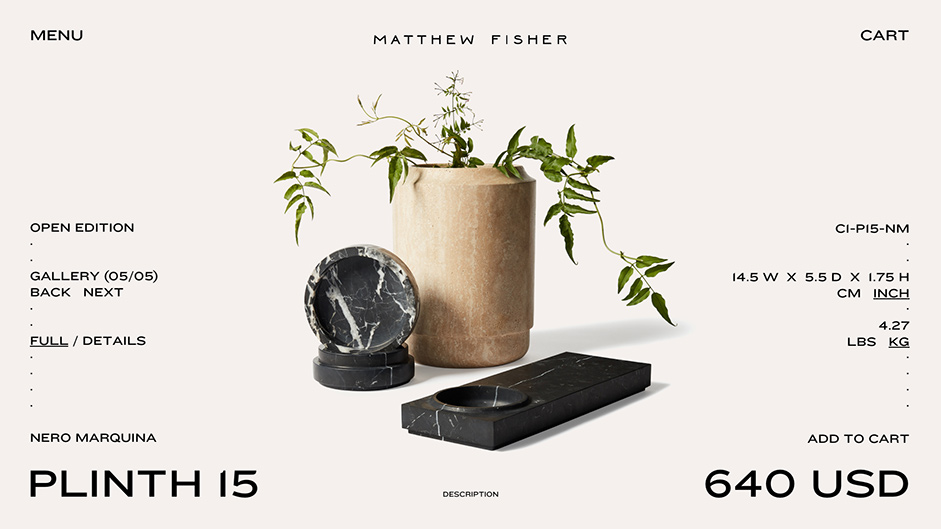
The PLINTH 15 product page in CUSP’s 2021 case study on Awwwards. It illustrates the arrangement of product, specification, and purchase information, not current prices, availability, website state, or a physical product test. Rights remain with the respective owners.
Before putting a story on a product page, identify the decision it changed
Many businesses say they are passionate about quality. Customers cannot necessarily see where that commitment took effect, or what difference it makes to them.
Three questions can help a team decide whether a piece of its story belongs in the shopping experience:
- What did this experience cause the team to change? It may have changed a material, construction detail, or production method. If the answer remains “we developed a greater love of life,” the product connection needs more work.
- What supports the explanation? Accurate specifications, process records tied to the item, sourcing information, or a genuine demonstration can be useful. Behind-the-scenes photography can create familiarity. A factory photograph alone cannot establish the origin or quality of every product.
- What judgment can the customer make with it? Can they distinguish two versions, understand maintenance requirements, or recognize that a particular model is unsuitable? If the content does not improve understanding, it may not deserve space near the buying decision.
These questions help decide what deserves explanation. They do not require three extra modules on every product page or insist that every brand present itself as a craft business. A brand centered on playful design can explain the origin of a pattern, how it is used, and the relationships within a collection.
Hedley & Bennett offers a more everyday example. Its story emphasizes professional kitchens; its Apron Guide explains straps, loops, pockets, and trade-offs between styles. Together, these brand-owned explanations let a customer connect that origin with practical questions. They do not replace an independent wear test. The brand’s story, its official selection guide
Evidence also needs to stay close to its explanation. When discussing an adjustable strap, show the adjustment point. When explaining why a size exists, provide a useful reference. If customers have to move between several pages to find the supporting detail, the connection becomes harder to follow.
A brand’s position should hold up when customers ask how to use the product
If a company encourages long-term use but offers no accessible cleaning, repair, or spare-part information, that position becomes difficult to sustain after purchase. The story is still being tested, now through practical support.
ASKET offers another useful perspective. In an official essay, its cofounder reflects on the company’s approach to manufacturing transparency and the limits of displaying numbers alone, emphasizing the people and resources involved in making garments. This is the brand’s argument, not independent evidence that consumer behavior has changed. ASKET’s official essay
Its site also provides fabric-specific Care Guides, with access to Repair Guides and spare parts. Our interpretation of this content arrangement is that a position about valuing clothing should be accompanied by help that customers can find when they use it. ASKET’s Care Guides
For another business, the practical task is to check whether its promises and support correspond. A durability claim needs appropriate care information and limits of use. A repair offering needs an explanation of what can be repaired, what information is required, and how to proceed. A service should never be invented simply to complete a persuasive brand narrative.
The same applies to tone. A business can sound approachable while stating its return conditions clearly. “We treat you like a friend” gives a customer very little to plan around when it takes the place of an actual policy.
Make the content maintainable so the story stays coherent
There is no need to begin by rewriting the entire site. One important collection, one representative product, and one recurring question about use are enough to start tracing the relationships and identifying gaps.
During implementation, give recurring information clear ownership: collection principles, product materials, process evidence, limits of use, and care instructions. Pages can assemble and present these elements. Avoid baking entire explanations into image files or letting the same specification drift into contradictory versions across several pages.
In a Shopify project, some of this information can be managed through structured product or collection fields and displayed through theme sections. The exact fields and reuse patterns should follow the existing theme and the editorial team’s work. Dynamic-source support also depends on the theme and the relevant section or block. Shopify’s official guidance A content model earns its place by making accurate communication easier to maintain; additional complexity is not a goal in itself.
Important explanations also need an owner. When a material changes, do the product details and process narrative change with it? If a repair service is paused, are the relevant pages updated? Once the story contributes to a purchase decision, checking it once before launch is insufficient.
Finally, let a few people from the intended audience begin directly on a product page. Observe whether they can explain what is distinctive about the item, why that difference exists, and whether it suits them. Record where understanding breaks down, then determine whether the cause is missing evidence, unclear language, or misplaced information.
Such observation can reveal comprehension problems. It does not establish that conversion will improve. It does, however, make the design discussion more useful: perhaps a structural photograph is missing, a sentence needs clarification, or a story belongs elsewhere so the customer can get a direct answer.
A brand does not need to recount its history in every corner of a store. Customers can get to know it through a recommendation with a clear basis, an honest explanation of a limitation, and help they can still find after buying. About Us can unfold the history. The shopping experience gives that history continuing meaning.
WESWOO — Shopify Storefront Development
We help Chinese brands expand internationally with storefront development and Shopify Plus integration services, supporting their cross-border commerce operations.
- Shopify storefront branding
- International UI design
- Multichannel social media marketing